


Key Takeaways
- Progressive lenses let you see far, in-between, and up close through one pair of glasses.
- They have no visible lines and offer a smooth shift between viewing zones.
- Adults 40+ with presbyopia often find these lenses helpful.
- Lens options include standard, custom-made, short corridor, computer, ground-view, and light-adaptive designs.
- Your eyes can adjust to new lenses with time and a few simple habits.
Progressive lenses are glasses that let you see at a distance, at arm’s length, and up close, all in one lens with no visible lines. A comprehensive eye exam with our team at The Eye Avenue can help you find out whether progressives suit your visual needs.
How Do Progressive Lenses Help You See Near& Far?
Each progressive lens blends several prescriptions together. You can see at different distances by looking through different parts of the lens.
3 Viewing Zones in 1 Lens
Each lens has 3 zones, stacked from top to bottom:
- The top zone helps with distance vision, like driving.
- The middle zone helps with in-between vision, like computer work.
- The bottom zone helps with close-up vision, like reading your phone or a menu.
How Progressive Lenses Compare to Regular & Bifocal Lenses
Regular lenses, also called single vision lenses, correct vision at one distance only. For instance, if your single vision glasses are for driving, you’d need a separate pair to read a recipe.
Bifocals and trifocals correct at more than one distance, but these lenses have visible lines that mark a sharp transition between correction zones. Progressive lenses shift gradually from one prescription to another, so they don’t need transition lines and they look like regular glasses.
Who Can Benefit from Progressive Lenses?
Progressive lenses can be a good fit for several groups of people:
- Adults 40+ with presbyopia (an age-related condition that makes it difficult to focus up close)
- People who switch back and forth between distance glasses and reading glasses.
- Anyone who wants one pair of glasses for all distances.
If you need correction at multiple distances and find yourself often switching glasses, progressives can help simplify your day.

Types of Progressive Lenses
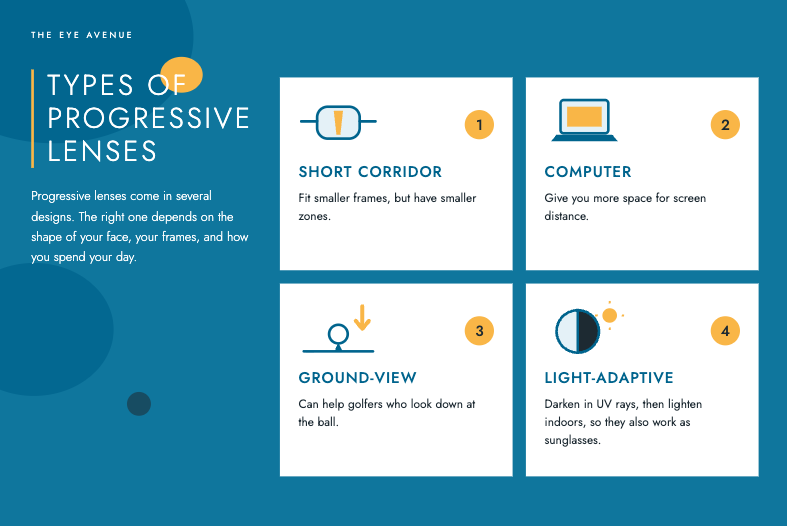
Progressive lenses come in several designs. The right one depends on the shape of your face, your frames, and how you spend your day. For instance:
- Short corridor lenses fit smaller frames but have smaller zones.
- Computer lenses give you more space for screen distance.
- Ground-view lenses can help golfers who look down at the ball.
- Light-adaptive lenses darken when exposed to UV rays, then light when you go back inside. This means that they also work as sunglasses.
If you often spend 8 or more hours at your laptop per day, computer lenses may be the right choice.
ZEISS ClearMind Progressive Lenses
ZEISS ClearMind is a new lens lineup designed using neuroscience. The ZEISS ClearMind Progressive lens is made for adults starting in their mid-40s who want easier shifts between near, in-between, and far vision.
These lenses feature wide, clear viewing areas and soft blur transitions at the edges, so your eyes can move naturally across distances. According to ZEISS, half of all wearers fully adapt within their very first hour.
If you’re not yet ready for progressives, the ClearMind lineup also includes options for other stages of life:
- ZEISS Single Vision ClearMind is designed for adults in their 20s and 30s and offers sharp, edge-to-edge vision at every distance.
- ZEISS Digital ClearMind is designed for adults in their 30s and mid-40s and includes a subtle power boost in the lower part of the lens to help ease eye fatigue from screen time and close-up work.
Dr. Regina Tran or Dr. John Tran can help you decide whether ZEISS ClearMind Progressive lenses fit your routine.
What to Expect as You Adjust to Progressive Lenses
New progressives take some getting used to. Knowing what’s normal can help you settle in.
What to Keep in Mind
Adjusting to new lenses can often take a few weeks. As your eyes adjust, you might find that your vision at the edges of your lenses looks blurry. You might also feel a little bit off-balance.
Progressive lenses also cost more than single vision lenses. However, one pair replaces separate distance and reading glasses.
Tips for Your First Few Weeks
These habits can help your eyes adapt:
- Point your nose at what you want to see, then tilt your chin up or down until it comes into focus.
- Look through the top zone when you walk or climb stairs.
- Wear your new glasses often.
- Take a break if a headache starts.
If headaches persist or worsen, our team can check your prescription and fit.
Find Progressive Lenses with Eye Doctors in Oviedo
If you’re interested in progressives, the process starts with an eye exam to check your current prescription. Dr. Regina Tran or Dr. John Tran can talk with you about your routine, from screen time to weekend golf, and help you pick a lens type that matches your needs.
Next, our optical team can help you choose frames and fit your lenses. You can try on frame and sunglass styles in person and see how each one looks on your face.
The Eye Avenue is in the Strand offices between VAMPD and Pure Barre. When you’re ready to see near and far with one pair, book a visit through the online appointment portal with the eye doctors in Oviedo.